Habits & mindset · Learn Anything Faster
How to learn faster, at any age
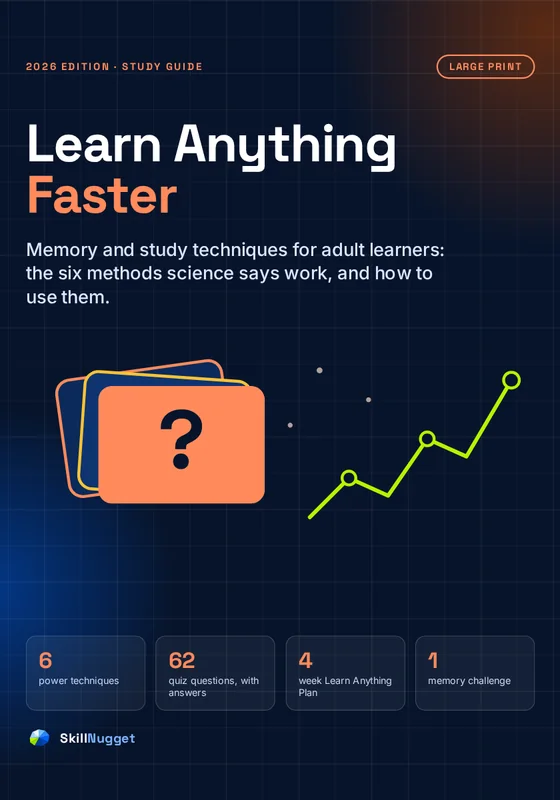
Learn Anything Faster teaches the six study techniques that research says work, and drops the ones that only feel like they do. For a new language, a course or exam, a work skill, an instrument or a hobby: how to remember more, in less time, and keep it for longer.
- 16 short chapters
- 62 quiz questions, with answers
- A 4-week Learn Anything Plan
- Flashcard kit + a memory challenge
Secure checkout by Polar Instant download Sign in by email, no password
Already bought it? Sign in to your library
What you'll be able to do
After reading, you'll be able to
- Remember what you study with retrieval practice, the most effective technique in the research (Chapter 5).
- Stop forgetting with a simple spacing schedule and a five-box Leitner system (Chapters 1 and 6).
- Understand, not just memorize by mixing, explaining and adding pictures and examples (Chapters 7 to 9).
- Memorize lists and sequences with the memory palace, the ancient technique memory champions still use (Chapter 10).
- Learn real things like a language, a physical skill or an exam, with plans for each (Chapters 11 to 13).
- Use AI without learning less with seven prompts that make you think more, not less (Chapter 14).
The toolkit
The book, plus a toolkit for learning anything
One purchase, five downloads, yours to keep. Print the flashcards and planner as often as you like, and save the surprise for Chapter 10.
-
The book
16 chapters on how memory works, six techniques and how to apply them, with 62 quiz questions, answers and a 4-week plan.
-
The Flashcard Kit
Five Leitner box labels, 16 ready-made cards on the techniques and 24 blank fold-over cards.
-
The Study Planner
The 4-week plan, a spaced review calendar, the 30-minute session sheet, a brain dump page and the Feynman page.
-
The surprise (open at Chapter 10)
A three-level challenge that shows you what your memory can really do. Most people think level 3 is impossible.
Free sample Download a free sample first: no email, no sign-up.
Free tool
True or false? The learning myths quiz
Twelve statements from the start of the book. Guess first: getting it wrong, then finding out, actually helps you remember.
Inside the guide
What's inside
Four parts, a myths quiz at the start, a quiz at the end of every technique chapter and a mixed final.
How memory really works
Why we forget, and why good learning feels hard.
- 01Why we forget (and why that's useful)
- 02Good learning feels hard
- 03Six myths to drop
- 04Sleep: the night shift
Six power techniques
What each one is, why it works and exactly how to use it.
- 05Retrieve: test yourself
- 06Space: come back later
- 07Mix: shuffle it up
- 08Explain: ask why
- 09Picture and example
- 10The memory palace
Learn real things
The techniques, applied.
- 11Learn a language
- 12Learn a physical skill
- 13Learn for a course or exam
- 14Learn with AI
- 15Focus and motivation
Your plan
Everything combined, then the final quiz.
- 16The 4-Week Learn Anything Plan
Free from the book
Six techniques to try this week
Each one takes a few minutes and works for almost anything you want to learn.
The brain dump
Then try: doing it again in three days, without looking first.
The spacing schedule
Then try: moving anything you forgot back to an earlier step.
Shuffle your practice
Then try: noticing which method each problem needs before you start it.
Explain it to a 12-year-old
Then try: teaching it out loud to a friend.
Guess first
Then try: checking your guesses as you read. Wrong guesses help too.
Ask AI to quiz you
Then try: asking it to mix in questions from last week's topic.
The book explains the research behind each one, from Ebbinghaus's forgetting curve to the 2006 testing-effect study and the memory palace study published in Neuron.
Look inside
Real pages from the book
Large type, clear diagrams and a quiz at the end of every technique chapter.


Free sample Read the first chapters before you buy.
The research, in one list
How ten study techniques were rated
In a major review of ten common study techniques (Dunlosky and colleagues, 2013), only two were rated "high utility". Here is the list the book is built on.
High utility
- 01Practice testing (quizzing yourself)
- 02Distributed practice (spacing)
Moderate utility
- 03Interleaved practice (mixing)
- 04Elaborative interrogation (asking why)
- 05Self-explanation
Low utility
- 06Summarization
- 07Highlighting and underlining
- 08The keyword mnemonic
- 09Imagery for text
- 10Rereading
Low utility doesn't mean useless: the keyword method is great for vocabulary, for example. The book shows when each one helps.
What you get
Everything that's inside
- The 66-page book in large print: 16 short chapters on how memory works, six techniques and how to apply them.
- 62 quiz questions a myths quiz, a Check yourself quiz in every technique chapter and a 20-question mixed final, with answers and explanations.
- Plans for real learning a language, a physical skill, a course or exam, and learning with AI.
- The 4-Week Learn Anything Plan with a 30-minute study session you can use for any subject.
- The Flashcard Kit Leitner box labels, 16 ready-made cards and 24 blank fold-over cards.
- The Study Planner a 4-week plan, a spaced review calendar, session sheets, brain dump and Feynman pages.
- A printable surprise a three-level challenge that shows you what your memory can really do (open it at Chapter 10).
- Research in plain English from Ebbinghaus to the latest studies, with every source listed.
This guide is for you if
- You're studying for a course, an exam or a certification.
- You're learning a language, an instrument or a new skill for work.
- You read things and forget them a week later.
- You were never taught how to study, only what to study.
It's not for you if
- You want speed-reading tricks or "photographic memory" promises. This book is about what research shows works.
Start this week
Get the guide and toolkit
Most people study the way they did at school: rereading and highlighting. It feels productive and works poorly. This book replaces it with six techniques that work, for anyone, at any age.
PDF guide + printable toolkit · 66 pages · 2026 edition
Learn Anything Faster
- The book · PDF · 66 pages · large print
- The Flashcard Kit · Printable PDF · 7 pages
- The Study Planner · Printable PDF · 5 printables
- The surprise (open at Chapter 10) · Printable PDF · about 30 minutes
Secure checkout by PolarRead anywhere, or print
Good questions
Questions people ask
Are learning styles real?
People have preferences, but a major 2008 review found almost no good evidence that matching teaching to a "learning style" helps. The book explains what works instead.
I'm over 50. Is it too late to learn?
No. Your brain keeps forming new connections throughout life, and adults have real advantages, like more knowledge to connect new ideas to. The book is written for adult learners.
Are there really quizzes?
Yes: 62 questions in all, with answers and explanations at the back. Testing yourself is one of the best ways to learn, so the book does it too.
What is the memory palace?
An ancient technique: you link things to remember to places along a route you know well. In a 2017 study, ordinary people who trained for six weeks more than doubled how many words they could recall.
What exactly do I download?
Five files: the 66-page book (PDF), the Flashcard Kit (PDF), the Study Planner (PDF), a printable memory challenge (PDF), and a free sample you can share.
Can I print it?
Yes. Everything prints on US Letter or A4. Print the printables as often as you like for your household.
Can I see some of it first?
Yes. Download the free sample (the welcome, the myths quiz and two chapters), and try the myths quiz on this page.
How do I get the files after paying?
Right after checkout you come back to your SkillNugget library, and we email you a sign-in link. Download the files there any time, on any device. No password needed.
Keep learning
Goes well with
Study less. Remember more.
Six techniques, a 4-week plan and a quiz for every chapter, for less than the price of a paperback.
Learn Anything Faster is a practical study guide. It is not medical advice. Research findings are summarized in plain English; see the Sources page in the book for full references. All quiz questions and examples were written for this book.